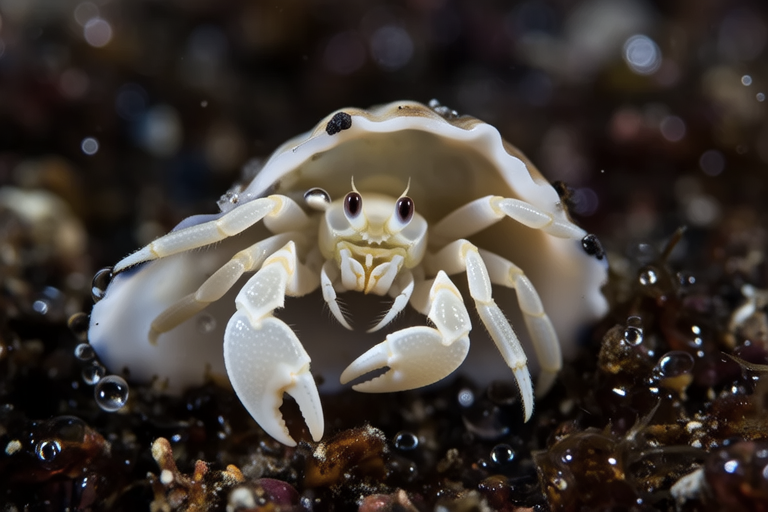
Discovering the World’s Smallest Crab Living Inside Clams
In the vast and mysterious world of marine life, there exists a fascinating and often overlooked relationship between a diminutive crab and its clam host. This unique symbiosis represents a delicate balance of interdependence that has intrigued marine biologists for years. The world’s smallest crab, known scientifically as Thaumastocheles pellucidus, dwells within the protective confines of clams, a partnership that exemplifies the intricate web of life beneath the waves.
The Symbiotic Relationship
The relationship between Thaumastocheles pellucidus and its clam hosts is a prime example of mutualism, where both parties benefit from the arrangement. The crabs, being so small, find refuge and protection from predators within the shell of the clam. In return, they assist the clam by cleaning out debris and detritus that accumulates inside the shell, thus helping to maintain the clam’s living space. This cleaning activity also aids in reducing the risk of harmful infections or parasites that could otherwise threaten the clam’s health.
The crabs’ small size, typically measuring less than 3 millimeters in length, allows them to maneuver easily within the narrow spaces of the clam’s mantle cavity. Their elongated legs and specialized claws are perfectly adapted for this role, enabling them to reach into the nooks and crannies of the clam’s interior to perform their cleaning duties efficiently.
Physical Characteristics
Thaumastocheles pellucidus is characterized by its translucent exoskeleton, which gives it a ghostly appearance, making it nearly invisible against the pale interiors of its host clams. Its body is segmented, with eight walking legs and two large claws, which are used primarily for defense and manipulating food particles. The crab’s eyes are mounted on stalks, providing it with a wide field of vision to detect threats and opportunities within its cramped quarters.
Despite its small size, the crab exhibits remarkable adaptability. It can change color slightly to blend in with different types of clams, enhancing its camouflage abilities and further protecting it from potential predators. The crab’s ability to thrive in such a specialized environment is a testament to the power of evolution and adaptation in the marine ecosystem.
Ecological Niche
The ecological niche occupied by Thaumastocheles pellucidus is one of precision and specialization. These crabs are found in shallow coastal waters, where they live symbiotically with various species of clams. They play a crucial role in maintaining the health of their hosts by keeping the internal environment clean and free from harmful substances. This cleaning process not only benefits the clams but also contributes to the overall health of the marine ecosystem by preventing the spread of diseases and reducing organic waste.
Additionally, the presence of these tiny crabs can indicate the health of the surrounding marine environment. If the population of Thaumastocheles pellucidus declines, it could be a sign of larger environmental issues affecting the ecosystem, such as pollution or changes in water quality. Understanding the factors that influence the crab’s survival can provide valuable insights into the broader health of marine habitats.
Discovery and Classification
The discovery of Thaumastocheles pellucidus is a story of perseverance and meticulous observation. First identified in the early 20th century, the crab was initially mistaken for a juvenile form of other crab species due to its size. However, through detailed studies and advancements in microscopy, scientists were able to distinguish it as a unique species.
The crab belongs to the family Thaumastocheiridae, a group of crabs known for their small size and specialized lifestyles. The genus name Thaumastocheles comes from the Greek words meaning “wonderful” and “claw,” reflecting the crab’s remarkable adaptations and its distinctive claws. The specific epithet pellucidus refers to the transparency of its body, highlighting one of its most striking features.
Classifying these crabs has been challenging due to their small size and the difficulty in obtaining sufficient samples for study. Advances in genetic analysis have provided additional tools for researchers to understand the evolutionary relationships and diversity within the genus, contributing to a more comprehensive understanding of these fascinating creatures.
Broader Implications
The discovery and study of Thaumastocheles pellucidus highlight the importance of exploring even the smallest corners of our planet. These tiny crabs serve as a reminder of the countless undiscovered species that may exist in our oceans, each playing a vital role in maintaining the delicate balance of marine ecosystems.
Understanding the adaptations and behaviors of such specialized organisms can provide valuable lessons in fields ranging from ecology to medicine. For instance, the crabs’ ability to thrive in confined spaces and under harsh conditions offers insights into engineering solutions for miniaturized robotics and medical devices. Moreover, the study of these crabs underscores the need for conservation efforts to protect marine environments, ensuring that such unique and beneficial relationships continue to flourish.
As we delve deeper into the mysteries of the ocean, we uncover a world filled with hidden wonders and surprising adaptations. The story of Thaumastocheles pellucidus serves as an inspiration to explore further, encouraging a sense of wonder and curiosity about the vast and diverse world beneath the waves.
